 866.633.1597
 Mon-Fri 8:30am-5:00pm CST




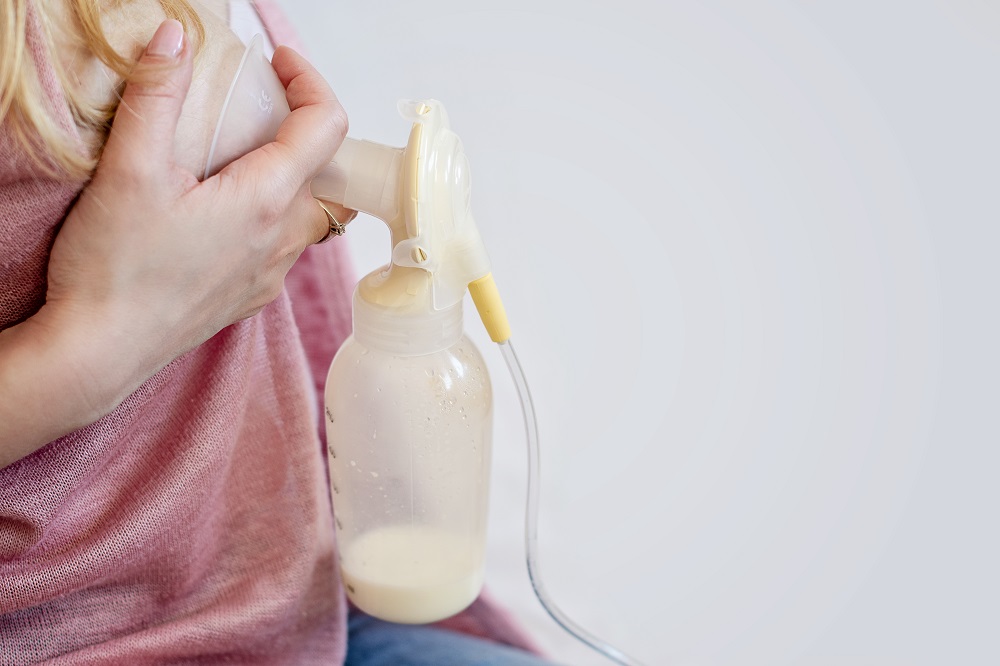
Why Breast Shield Size Matters?
Do your breasts hurt while you are pumping? Are you not getting as much milk as you think you should? The problem may not be with your pump or your milk supply – it could simply be that you don’t have the right breast shield size for your breasts. The good news is that fixing your flange fit is usually simple. Below, Neb Medical Services walks you through how to measure, what a good fit looks like, how to tell whether your shield is too big or too small, and which sizes and inserts are available for popular pumps.
What Is a Breast Pump Shield (Flange)?
Flanges, also known as breast shields, are the plastic cone-shaped pieces that fit over your breasts while you’re pumping. All electric breast pumps come with at least two flanges, which are usually a standard size of 24 to 27 millimeters (mm). But not all women’s nipples will fit the standard size. The flange size refers to the inside diameter of the “tunnel,” the narrow part of the shield your nipple is drawn into during pumping. Most manufacturers offer flanges in 3–4mm increments (for example, 21mm, 24mm, 27mm, 30mm), so many moms land somewhere in between two sizes. That’s where flange inserts come in (more on those below).
Problems Caused by the Wrong Flange Size
Using the wrong breast shield size may not seem that important, but it can cause significant problems. Having a breast shield size that is too big or too small can cause pain in your breasts as well as cause you to not pump as much milk as you should, which can lead to blocked milk ducts. Over time, a poor fit can also contribute to nipple damage, reduced milk supply, and frustration that makes pumping feel harder than it needs to be.
Signs Your Breast Pump Shield Fits Properly
- You don’t experience any pain in your nipple
- Your breasts feel completely empty after pumping, and there aren’t any spots that still have milk inside
- Your areola doesn’t enter the tunnel part of the flange
- Your nipple moves freely inside the flange
- Your nipple doesn’t turn white
Signs Your Flange Is Too Small vs. Too Large
If something feels off, it helps to know which direction to adjust. Here’s a breakdown of the most common signs.
Signs Your Flange Is Too Small
- Friction and rubbing: Your nipple rubs against the sides of the tunnel with each pump cycle instead of moving freely.
- Pinching or squeezing: It feels like the tunnel is gripping or compressing your nipple.
- Redness, cracks, or blisters on the sides of the nipple from repeated rubbing.
- Nipple turns white or blanches after pumping, which can be a sign of restricted blood flow.
- Slow or reduced milk flow, because a tight tunnel can compress milk ducts.
- Plugged ducts or lumpy areas that don’t soften after pumping.
What to try: Size up to the next flange size.
Signs Your Flange Is Too Large
- Too much areola pulled into the tunnel: If a large portion of your areola is being drawn in with each suction cycle, the tunnel is likely too wide.
- Swelling of the nipple or areola after pumping, sometimes with a “ring” or puffy edge around the areola.
- Nipple trauma at the tip or base, such as elongation, soreness, or bruising from being pulled too deeply into the tunnel.
- Nipple bouncing or “flopping” loosely in the tunnel instead of gliding smoothly.
- Poor seal or lost suction, so the pump doesn’t seem to work as well as it should.
- Breasts still feel full after a session.
What to try: Size down to a smaller flange or try a flange insert to reduce the tunnel diameter.
How to Measure Flange Size (Medela Guide)
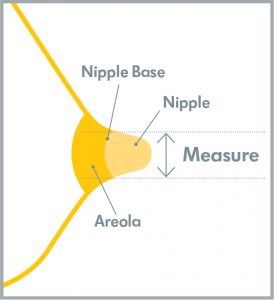
How to measure your nipples (Courtesy Medela)
To avoid any of those problems, it’s best to measure your nipples before you buy your pump to make sure you have the right flange size from the beginning.
Here’s a guide on what to do: Get out a ruler or measuring tape and measure the diameter of your nipple at its base, which means the distance straight across the nipple at the bottom. Make sure to not include the areola! The areola is the darker colored skin around the nipple. Also, make sure to measure it in millimeters (hint: 1 cm = 10 mm). Once you get the measurement, add about 2 to 5 millimeters to get your correct flange size.
For example, if your nipple width is 17mm or less, you’ll want to get a 21mm size flange. If it is 20mm or less, you should get a 24mm flange. If it is 23mm or less, go with the 27mm flange. If it is 26mm or less, go with the 30mm flange. And if it is 32mm or less, you’ll need the 36mm flange.
A Quick Note About the Sizing Formula
The “nipple diameter +2–4mm” rule is a helpful starting point, but it isn’t based on strong clinical evidence. Every mother’s body is different, and factors like nipple elasticity, breast tissue, and how your nipple responds to suction all play a role. Think of finding your flange size like shopping for shoes: your measurement tells you where to start, but you may need to try a size up or down before you find the one that feels right. Some moms end up comfortable with a flange that’s only 1–2mm larger than their nipple, while others need a bit more room.
If you’re unsure, struggling with pain, or just can’t seem to find the right fit, an International Board Certified Lactation Consultant (IBCLC) can assess your fit in person and recommend sizes or inserts. It’s one of the most worthwhile appointments you can make for your pumping journey.
Breast Shield Sizes by Brand
Below is a list of all of the breast pump manufacturers that we carry and the standard size flanges they come with:
- Ameda – 25mm and 28.5mm (Ameda Joy), or 24mm and 28.5mm (Ameda Mya)
- Ardo – 26mm (Ardo Calypso) or 26mm and 31mm (Ardo Calypso To Go Pure, which also comes with breast shell inserts for 28mm)
- Baby Buddha – 24mm
- Elvie – 24mm and 28mm
- Lansinoh – 25mm
- Medela – 24mm and 27mm (except for the Medela Freestyle Flex, which comes with 21mm and 24mm)
- Motif – 24mm
- Rumble Tuff – 24mm
- Spectra – 24mm and 28mm
- Unimom – 24mm and 28mm
- Zomee – 24mm and 28mm
Additional Flange Sizes Available for Medela
If the standard breast shield size that comes with your pump doesn’t work for you, you can order smaller- or larger-sized flanges from us or the manufacturer. Here is a list of the different size flanges you can order through us: Medela – 21mm, 24mm, 27mm, 30mm, 36mm
Remember, pumping isn’t supposed to hurt! Getting the correct size flange will make a world of difference in your pumping experience.

