866.633.1597
  Mon-Fri 8:30am-5:00pm CST



Learning how to choose a breast pump can feel overwhelming, especially when you’re a first-time parent staring down a long list of brands, models, and features. The good news? Picking the right breast pump doesn’t have to be complicated once you understand the basics. In this guide, we’ll walk you through the different types of pumps, what to look for, how to get one through your insurance, and seven simple questions that will help you find the perfect fit for your pumping lifestyle.
When it comes to choosing a breast pump, we know there are lots of different pumps to pick from. And having so many good options to choose from can be very overwhelming and hard to know what pump would be best for you.
And unfortunately, you may not know what breast pump will be best for you until you start to pump.
However, there are a few things you should consider before your baby arrives that will help guide you towards choosing the best pump for you.
Understanding the Different Types of Breast Pumps
Before we jump into the questions, it helps to understand the main categories of breast pumps available today. Each type serves a slightly different need, so knowing the differences is the first step in choosing the right breast pump for you.
Manual Breast Pumps
A manual pump is operated by hand, using a lever you squeeze to create suction.
- Pros: Affordable, lightweight, quiet, no batteries or outlet needed, and great for occasional use or relieving engorgement.
- Cons: Requires hand effort, only pumps one breast at a time, and isn’t ideal for frequent or exclusive pumping.
Double Electric Breast Pumps
These are the most popular choice for working parents. They pump both breasts at once using a motor.
- Pros: Efficient (pumping both sides saves time), adjustable settings, and usually covered by insurance. Ideal for daily and exclusive pumping.
- Cons: Heavier than manual or wearable options, and most require an outlet or rechargeable battery.
Hands-Free / Wearable Breast Pumps
These pumps tuck right into your bra so you can pump on the go without being tethered to a wall.
- Pros: Discreet, portable, and let you multitask while pumping.
- Cons: Generally have less suction power than traditional electric pumps, smaller milk capacity, and a higher price point.
Multiuser / Hospital-Grade Breast Pumps
These powerful pumps are designed to be used by more than one person (with separate accessory kits) and are often rented.
- Pros: Strongest, most efficient suction, excellent for establishing or boosting supply, and ideal for moms of preemies or multiples.
- Cons: Larger, heavier, and typically more expensive to rent or buy.
Silicone Milk Savers / Collectors
Not technically a pump, but worth mentioning! A silicone milk saver uses gentle suction to catch letdown from the breast you’re not nursing on.
- Pros: Inexpensive, simple, and a great way to save milk you’d otherwise lose.
- Cons: Won’t fully empty the breast and can’t replace a real pump.
Closed System vs. Open System Pumps
One of the most important things to understand when choosing a breast pump is the difference between a closed system and an open system pump.
A closed system pump has a barrier (often called a backflow protector) between the milk collection kit and the pump motor and tubing. This barrier prevents milk particles and moisture from getting into the tubing or motor.
An open system pump does not have this barrier, which means milk vapor can travel into the tubing and motor, where it can be nearly impossible to fully clean and sanitize.
Most lactation experts strongly recommend choosing a closed system pump for hygiene and safety reasons. Because closed systems prevent contamination, they’re cleaner, easier to maintain, and help protect your milk from mold or bacteria.
This is also why you should never buy or use an open system pump secondhand. Since milk residue can get trapped inside an open system, a used open system pump may carry bacteria or viruses from the previous user. Closed system pumps (with brand-new personal accessory kits) and multiuser/hospital-grade pumps are designed to be shared safely, but open system pumps are not.
How to Get a Breast Pump Through Your Insurance
Here’s some good news: thanks to the Affordable Care Act, most insurance plans are required to cover the cost of a breast pump. That means many electric breast pumps are available to you at little or no cost!
So how do you qualify? In most cases, all you need is:
- An eligible insurance plan (most major plans qualify).
- A prescription from your healthcare provider (some plans require this, some don’t).
- To order through an in-network medical equipment supplier like Neb Medical Services.
Here at Neb Medical, we handle the paperwork for you. Our team works directly with your insurance company to verify your benefits, find out which pumps you qualify for, and ship your pump right to your door. It’s worth ordering early in your pregnancy so your pump is ready and waiting before your baby arrives.
A Quick Word on Suction Strength
When comparing pumps, you’ll often see suction strength listed in mmHg (millimeters of mercury), which is the unit used to measure vacuum pressure. Most electric breast pumps fall somewhere in the 220 to 350 mmHg range.
It’s tempting to assume that a higher number means a better pump, but that’s not necessarily true. Comfort matters far more than chasing the highest suction number. Cranking the suction up too high won’t empty your breast faster, but it can cause pain and nipple damage. The most effective pumping happens at the highest setting that still feels comfortable to you, not the strongest setting the pump can reach.
Here are seven questions to ask yourself when choosing a breast pump:
1. Is this your first baby?
If this is NOT your first baby, you will want to think about how things went when you were breastfeeding and pumping before. Take notes on things you either liked or didn’t like about the first breast pump you had.
Although some insurance companies only allow you to get one breast pump in your lifetime, most will allow you to get a new pump with each pregnancy. And since it’s likely been a while since you last got a breast pump, there are likely many new brands and models on the market to choose from.
If you did not breast feed at all with your first baby, or this is your first pregnancy, then you can start at question #2.
2. Do you have a room at work or school where you can pump with an outlet?
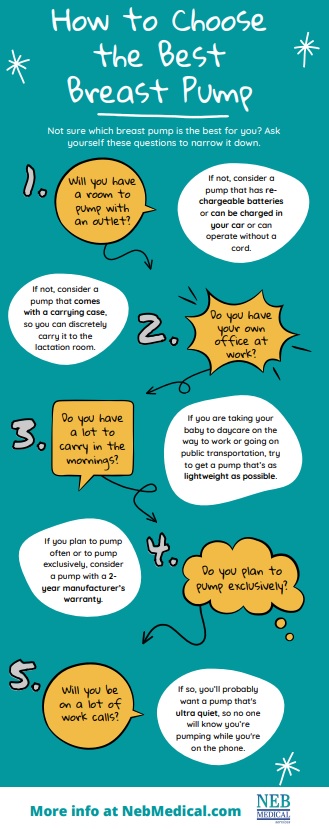
If not, consider looking for breast pumps that have either re-chargeable batteries or can be charged in your car or can operate without a cord. Although the pump suction will always be best when the unit is plugged into the wall or on full strength battery, it’s great to have the option to pump in your car when you need to, especially if you’re in a job or at a school where you don’t have access to a private room with an outlet.
Breast Pumps That Work with a Car Adapter (sold separately):
- Ardo Calypso
- Lansinoh Signature Pro and Lansinoh Smartpump
- Spectra S1, Spectra S2, and Spectra S9 Plus
Breast Pumps That Have Rechargeable Batteries:
Breast Pumps With a Long Battery Life:
- BabyBuddha – 3 hours
- Ameda Mya with Large Tote – 2 hours
3. Do you have your own office at work?
If you’re a manager with your own private door, hooray! You can probably find a place to stash your pump where people won’t see it. But if you aren’t lucky enough to have your own private office, you may want to consider a pump that comes with a carrying case, so you can discretely carry it from your cubicle to your lactation room a couple of times each day.
Breast Pumps With a Carrying Case:
4. Will you be taking your baby to daycare before you go to work?
If so, try to get a pump that’s as lightweight as possible. A 5 lb. pump may not seem like a lot, but when you’re trying to get out of the house with your baby, your diaper bag, your purse, your lunch AND your pump, you’re going to feel it. (Also, if you are schlepping a lot to and from work, you might want to consider buying a second pump just to have at work).
Breast Pumps That Weigh 1 lb. or less:
5. Do you plan to pump exclusively?
Most moms use an electric breast pump to pump during the workday when they are away from their baby. But some moms choose to pump exclusively (which means not nursing at all from the breast). This may be necessary if your baby has any health issues or if you experience any problems with getting your baby to latch correctly. If you plan to pump often or to pump exclusively, you might want to consider a pump with a good manufacturer’s warranty. Not all pumps are made for exclusive pumping, so take that into account.
If you’re planning to pump often or exclusively, there’s another feature worth paying close attention to: the ability to adjust cycle speed and vacuum strength independently.
Here’s what those terms mean:
- Cycle speed controls how fast the pump moves through its suction rhythm. Faster cycles mimic the quick sucking your baby does at the start of a feed to trigger letdown, while slower cycles mimic the deeper, slower pulls that empty the breast.
- Vacuum (suction) strength controls how strong each pull is.
On many basic pumps, these two settings are tied together, meaning you can’t increase suction without also speeding up the cycle. But more advanced pumps let you control each one separately. This is a big deal for exclusive pumpers and full-time working parents, because being able to fine-tune both settings helps you mimic your baby’s natural feeding pattern, drain your breasts more thoroughly, and stay comfortable during longer or more frequent sessions.
Breast pumps that allow independent cycle and vacuum adjustment:
- Spectra S1, Spectra S2, Spectra 9Plus
- Ameda Mya with Large Tote
Breast pumps with 2-year motor warranties:
6. Will you be on a lot of conference calls?
If so, you’ll probably want a pump that is ultra quiet, so even if you’re talking on the phone, no one will know you’re pumping at the same time. Just remember not to get on a video conference call!
Breast Pumps That Are Super Quiet
7. What is your nipple size?
How successful you are with pumping may have a lot less to do with the type of pump you choose and more to do with the size of flange you are using. Your output of milk will be much greater (and your nipples will thank you) if you are using a proper flange size. That’s why it’s helpful if the pump comes with more than one flange size or an insert so you can try out what works best. (Most pumps also have different size flanges available separately for purchase).
In fact, many lactation consultants will tell you that flange sizing is the single most important factor in a comfortable, productive pumping experience. As one common piece of expert advice goes, “It’s not the pump that’s the problem, it’s the flange.” A flange that’s too big can pull in too much areola and cause pinching or pain, while a flange that’s too small can compress the nipple and restrict milk flow.
Getting the right fit matters for three big reasons:
- Less pain and nipple damage. A properly fitted flange lets the nipple move freely without rubbing against the sides of the tunnel, dramatically reducing soreness, chafing, and cracking.
- More milk output. When your nipple isn’t being squeezed or restricted, milk can flow more freely, which often means a noticeably better output.
- Better breast emptying. A correct fit helps drain the breast more completely, which protects your milk supply and reduces your risk of clogged ducts.
If you’re experiencing pain while pumping, the flange size is almost always the first thing to check, before you ever blame the pump itself.
To determine your correct flange size, hold up a ruler to your nipple and measure it’s width, not including the do not include the areola or outer edge in your measurement. One centimeter equals 10 mm, and the average flange size is 24 mm wide, but you can get flanges as small as 20 mm to as large as 36 mm, depending on the manufacturer.
Breast pumps that come with multiple flange sizes:
- Ameda Mya with Large Tote (24mm and 28mm)
- Spectra S1, Spectra S2 and Spectra 9Plus (24mm and 28mm)
Putting It All Together
Choosing the right breast pump really comes down to matching the pump to your daily life. Start by deciding which type of pump fits your routine (manual, double electric, wearable, or hospital-grade), make sure you’re choosing a closed system pump for safety, and then use the seven questions above to narrow down the features that matter most to you. Don’t forget to prioritize comfort, especially when it comes to suction strength and flange fit, over flashy specs.
Here at Neb Medical our customer service team is trained and ready to help guide you towards finding the best pump to fit your daily pumping lifestyle. Just give us a call and our customer service representatives can answer any questions you have.
(Click on infographic below to see it larger).