866.633.1597
 Mon-Fri 8:30am-5:00pm CST





So, you’ve FINALLY hit your stride with breast pumping. You have the schedule just right, and you’ve selected the ideal breast shield and power setting for your needs. But out of the blue, you start losing suction when it matters most. So, what’s the problem?
Well, it turns out that the various components of your breast pump need to be replaced regularly. Breast pump parts can get damaged by wear and tear, and membranes can get torn or stretched out. Depending on how often you pump and what power settings you select, some breast pump parts will need to be replaced regularly.
Here’s a simple guide on when to replace your breast pump parts.
Why Timely Replacement Matters
Before we get into the specifics, it’s worth understanding why this matters so much. Replacing your breast pump parts on time isn’t just about keeping things tidy—it directly affects your pumping experience and your milk supply.
- Hygiene and safety: Worn, cracked, or discolored parts can harbor bacteria and mold in tiny crevices that are nearly impossible to clean. That’s a risk you don’t want anywhere near your milk.
- Suction and efficiency: As membranes and valves stretch out, your pump loses suction. Weaker suction means less milk removed, longer pumping sessions, and more frustration.
- Protecting your milk supply: Because your body makes milk based on demand, a pump that isn’t emptying your breasts effectively can actually signal your body to produce less over time.
- Cost savings: Replacing a few inexpensive valves or membranes every couple of months is far cheaper than wearing out your motor or feeling like you need to buy a whole new pump.
At Neb Medical Services, we often remind parents that a small, well-timed replacement can save you a lot of stress down the road. And remember—every mother and every pumping routine is a little different, so use these guidelines as a starting point and listen to what your equipment (and your body) is telling you.
Quick-Reference Replacement Guide
Here’s a scannable breakdown of how often to replace each part, based on how frequently you pump. Think of these as general guidelines rather than hard rules—inspect your parts regularly and replace sooner if you notice signs of wear.
Part Pumping 3+ Times/Day Pumping Fewer Than 3 Times/Day Replace Immediately If:
- Duckbill / Duck Valves Every ~4 weeks Every ~8–12 weeks Torn, stretched, or losing suction
- Valve Membranes (white) Every ~2–4 weeks Every ~4–8 weeks Cracked, warped, or not sealing
- Backflow Protectors Every ~3 months Every ~6 months Torn or stretched silicone
- Breast Shields / Flanges Every ~6 months Every ~6 months Cracks or tears appear
- Tubing Every ~3–6 months Every ~3–6 months Any sign of mold or moisture inside
- Storage Bottles & Connectors Every ~6 months Every ~6 months Cloudiness, cracks, or warping
When to Replace Breast Pump Valves?
Duck valves, or duckbills, are a single piece made of silicone, that look a bit like a duck’s beak. They stretch and release each time the pump motor pulls at the valve, creating the suction necessary to remove breast milk from your breasts.
If you pump three or more times per day, you should replace duck valves every four weeks. If you pump fewer than three times per day, replace every eight to 12 weeks.
Spectra breast pumps usually use duck valves. Spectra recommends washing duck valves with hot, soapy water and a clean brush to extend the life of the valve. Washing duck valves in a dishwasher is not recommended by Spectra.
The second most-commonly used valve, simply known as a valve, comes in two parts: the plastic valve and the round white valve membrane. These valves are commonly used in Medela breast pumps. Again, depending on frequency of use, the plastic valve and the white membrane should both be replaced every two to eight weeks. Replace as needed if the valve is damaged or cracked.
Signs it’s time to replace your valves or membranes:
- You notice weaker suction or slower milk flow
- The membrane looks stretched, warped, or no longer lays flat
- You see cracks, tears, or discoloration
- Milk is leaking where it shouldn’t
- Your pump sounds different or seems to be working harder than usual
When to Replace Breast Pump Tubing?
Tubing connects your breast pump motor to the other components and the collection bottle. Generally, all tubing should be replaced every three to six months, but replace immediately if there are any signs of mold. Don’t bother trying to clean your tubing. As soon as you notice black spots in it, just throw it out.
Spectra recommends replacing tubing immediately if breast milk or other moisture gets into the pump because it can damage the motor, or if it easily slides off when not in use. However, Medela says that tubing can be washed or dried if moisture threatens the pump. Otherwise, replace every three to six months.
Care tip: how to dry wet tubing. If you notice condensation or droplets inside your tubing after pumping, don’t just set it aside to air dry with water trapped inside—that’s exactly how mold gets started. Instead, disconnect the tubing from the collection parts, leave it connected to the pump motor, and let the pump run for a few minutes. The airflow will push the moisture out and dry the inside before you store it. This simple habit can noticeably extend the life of your tubing.
Signs it’s time to replace your tubing:
- Black spots or any discoloration inside the tubing (mold)
- Moisture or milk that won’t fully dry out
- Tubing that slides off easily or no longer fits snugly
- Visible cracks, kinks, or stiffness
When to Replace Breast Pump Backflow Protectors?
The backflow protector is a round piece of soft (usually white) silicone that prevents milk from the breast shield from backing up into the tubing to the pump. If you pump three or more times a day, the backflow protector should be replaced every three months. If you pump fewer than three times a day, replace every six months. Replace backflow protectors immediately if they become torn or stretched out.
Signs it’s time to replace your backflow protector:
- The silicone membrane looks stretched, cloudy, or discolored
- You notice reduced suction during sessions
- Milk is getting into your tubing (a clear sign the protector is failing)
- The silicone is torn or no longer sits flat
Replacement Backflow Protectors
Spectra Breastshield Set (includes backflow protector)
When to Replace Breast Shields/Flanges?
The breast shield, or flange, is the hard, plastic cone that connects to your breast. Breast shields should be replaced every six months, or sooner if you notice cracks or tears on the shield.
As with all breast pump components, inspect all parts closely during the regular cleaning process. Cleaning is a good time to take note of any damage, or wear and tear to the components. Also, sudden loss of suction can be caused by damage to any one of the components, so check each part thoroughly to find the culprit.
Signs it’s time to replace your breast shields/flanges:
- Hairline cracks or chips in the plastic
- Cloudiness or discoloration that won’t wash away
- A rough or scratchy surface that could irritate your skin
- A loss of suction or a poor seal against your breast
Replacement breast shields
Medela PersonalFit Breast Shields
When to Replace Storage Bottles and Connectors?
It’s easy to overlook the bottles and connectors since they feel so sturdy, but they wear out too. Storage bottles and connectors should generally be replaced about every six months, or sooner if you spot any signs of wear.
Because these parts go through repeated washing, heating, and cooling, the plastic can gradually break down over time. Cracks and cloudiness aren’t just cosmetic—they can create spots where bacteria hide and can also cause leaks or a poor seal that affects suction.
Signs it’s time to replace your bottles and connectors:
- Cloudiness, discoloration, or a filmy residue that won’t clean off
- Cracks, chips, or warping (often from heat or repeated sterilizing)
- A loose or wobbly fit between the connector and other parts
- Leaking at the connection points
- Lingering odors even after a thorough cleaning
And remember, because every mother and every pumping routine looks a little different, these timeframes are meant to guide you, not box you in. When in doubt, trust what you see and feel. If something looks worn or your pump just isn’t performing like it used to, it’s probably time for a fresh part. If you need help figuring out which replacement parts you qualify for through your insurance, the team at Neb Medical Services is always here to help.
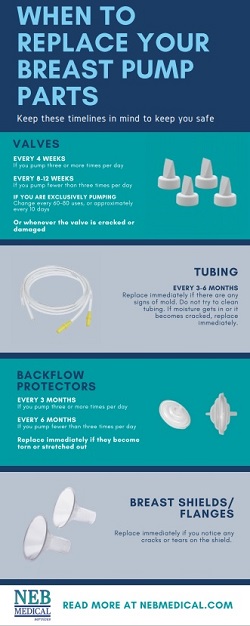
When to Replace Your Breast Pump Parts — Infographic
(Click below to see the image larger)